Anker SOLIX C1000 vs DJI 1024Wh Power Station
We compare the Anker SOLIX C1000 and the DJI 1024Wh Power Station across every dimension that matters - our scores, the key specs, and how each performs on the things you will actually notice day to day.

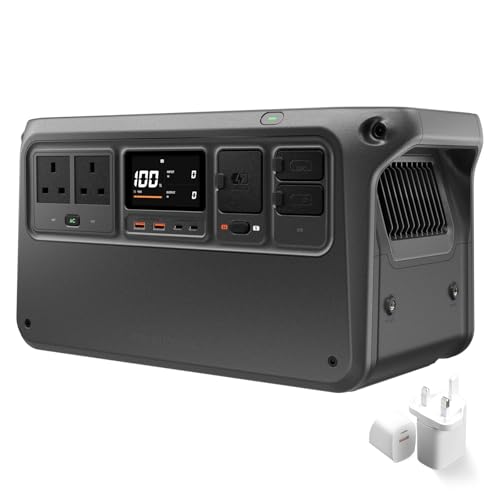
At a glance
| Anker SOLIX C1000 | DJI 1024Wh Power Station | |
|---|---|---|
| Our score | 9.5/10 | 8.1/10 |
| Best for | Home backup, caravans and running larger appliances | Home backup, caravans and running larger appliances |
| Not ideal for | Whole-home backup without a much larger system | Whole-home backup without a much larger system |
| Brand | Anker | DJI |
Capacity and What It Powers
Anker SOLIX C1000
This portable power station (Model A1763) uses a 1,024Wh LiFePO4 battery as its main energy store, which sets the practical ceiling for how long it can run devices before it needs recharging. In Anker SOLIX C1000 review terms, runtime depends on the total draw, so higher-demand equipment reduces run time more quickly. The Anker portable power station review also states it is rated to power up to 9 devices, as long as the combined needs stay within its 2,000W output limits. Its LiFePO4 design is positioned for a long service life, although real-world charging performance still depends on how it is used.
DJI 1024Wh Power Station
With a 1024Wh capacity and a rated 2600W output, the DJI is sized for running common appliances for short-to-medium sessions, including camping, DIY work, and home backup. Typical uses include powering kettles, cookers, projectors, and power tools such as saws and drills, as listed for the portable power station. Runtime depends on the connected load, with higher-draw devices draining the 1024Wh battery faster. The LiFePO4 design supports long use cycles, but capacity still limits continuous operation.
Output and Ports
Anker SOLIX C1000
With an output rating of 2,000W and a stated 3,000W peak, the portable power station (Model A1763) is designed to run higher-power appliances provided the combined load stays within those limits. It provides 2,000W output via 9 ports, allowing up to nine devices to run at once, which is a key differentiator versus single-port power setups. The trade-off is straightforward: higher draw items reduce how many other devices can operate simultaneously because total output must fit the 2,000W limit. UPS backup is listed as under 10 ms.
DJI 1024Wh Power Station
Even though capacity sets the overall energy limit, output and ports determine what can run at the same time, and how devices connect. The DJI is rated for 2600W output, which makes it suitable for larger appliances as long as the total load stays within that limit. Its ports include dual 140W USB-C connections, providing up to 280W in total across those ports, which supports faster charging than single-port setups, though the overall draw still matters. AC output is available for standard UK-style needs. Each device's input requirements should be checked, then loads should be split across ports to avoid overloading any single connection.
Recharging and Solar
Anker SOLIX C1000
Recharging on the Anker (Model A1763) is a key part of its day-to-day use, particularly when mains power is limited. With a portable power station with solar panel setup, the manufacturer states that mains charging can fully recharge in about 1.8 hours. It also claims ultra-fast charging up to 1,600W, which can be activated in the portable power station app. For off-grid use, the manufacturer states that solar recharging can also reach a full charge in about 1.8 hours when 600W solar (60V max) is connected. If the available solar is weaker, recharge time will be longer.
DJI 1024Wh Power Station
Recharging is a core part of owning the portable power station, because refill speed shapes practical runtime planning. For grid charging, the manufacturer states the unit supports fast charging, and the package includes an AC power cable for that purpose. For outdoor charging, the DJI 1024Wh Power Station solar generator route depends on using a compatible solar input. A buyer should plan for slower solar recharge than grid charging, and use daylight top-ups to reduce downtime. The recharging workflow is straightforward: connect the AC power or compatible solar input, wait for the unit to recover, then resume running connected loads.
Battery Type and Lifespan
Anker SOLIX C1000
Battery type and lifespan matter because they determine how long a portable power station stays useful when it is charged and discharged frequently. The Anker SOLIX C1000 uses a LiFePO4 battery, which The Anker lists as having a typical 3,000+ cycles. The portable power station also claims that after 4,000 cycles the battery still holds at least 80% capacity. For shoppers searching "anker solix c1000 amazon", the question "is the anker solix c1000 any good" is supported by these battery longevity figures.
DJI 1024Wh Power Station
Battery type and lifespan are central to how the DJI holds up over time, because long-term performance depends on both recharging behaviour and battery wear. It uses a LiFePO4 battery, which the manufacturer describes as a long-life option with a 10-year lifespan, supported by an intelligent BMS. Typical cycle expectations are 3000+ cycles, though real-world results vary based on load and charging habits. Durability is the main advantage, while the main downside is that lifespan can reduce with misuse.
Portability and Build
Anker SOLIX C1000
The Anker's SOLIX C1000 (model A1763) is built to be moved and stored with less hassle than larger power stations. In the UK context, its 11.29 kg weight and 38.4 x 20.8 x 24.4 cm size make it easier to transport, particularly as a portable power station for camping. The manufacturer states this Gen 2 unit is 14% smaller and 11% lighter than similar models, which helps with fitting it into vehicles or tighter storage. Build quality is positioned for long-term daily use.
DJI 1024Wh Power Station
The portable power station is designed to be moved between locations without needing a full-sized generator setup, and its compact body helps with portability. It measures 44.8 L x 22.5 W x 23 H cm, making the footprint easier to store in cupboards, caravans, and vehicle boots in the DJI setup, though it still requires clear carrying space. The housing is made for outdoor use, and the battery uses LiFePO4 chemistry, which supports a long service life. As a portable power station for camping, it is typically easier to transport than heavier alternatives, but bulk can still matter when carrying alone.
Who Is This Power Station For?
Anker SOLIX C1000
Given its 1024Wh capacity, 2000W rated output, and compact size of 38.4 x 20.8 x 24.4 cm, with a weight of 11.29 kg, the portable power station (A1763) suits people who need portable off-grid or backup power. It is suited to households looking for practical support during brief outages, because it supports under-10 ms UPS switchover. The unit also suits users with multiple small devices because it provides 2,000W across 9 ports. Recharge speed is a plus.
DJI 1024Wh Power Station
The portable power station is best suited to people who need portable backup power for day-to-day essentials in the UK, rather than heavy, continuous loads. Its compact footprint makes it a practical match for camping kit and everyday household charging needs, particularly when the goal is to keep smaller appliances running during short outages. For homeowners considering whether this portable power station is any good, the 1024Wh capacity and 2600W rated output align it with intermittent use cases such as device charging and brief backup power. It is also a strong option when searching for a power station for power cuts where quiet operation and fast recharging are priorities.
Anker SOLIX C1000: pros
- 1024Wh capacity
- 2000W rated output (000W surge peak)
- Long-life LiFePO4 battery
- Recharges in about 1.8 hours
Cons
- Solar panel usually sold separately
- Not a substitute for whole-home backup
DJI 1024Wh Power Station: pros
- 1024Wh capacity
- 2600W rated output
- Long-life LiFePO4 battery
- Quiet, fume-free portable power
Cons
- Solar panel usually sold separately
- Not a substitute for whole-home backup
Our verdict
Our pick is the Anker SOLIX C1000 (our score 9.5/10) - A practical portable power station with 1024Wh capacity and long-life LiFePO4 cells, best matched to the device wattages and runtime you actually need. The DJI 1024Wh Power Station is still worth it if it is cheaper when you check, or if it better matches your specific needs.